CRMs – Contact Relationship Management tools – have been a go-to tool for top sales performers for decades. Why? Because they help you organize your work to get more done in less time. Less time per prospect means you can help more prospects get into their new homes.
If you are not using a CRM, you could easily think that you’re doing fine without it; that you’ve got a ‘system’ that works for you and “if it ain’t broke, don’t fix it.” You wouldn’t be the first to think that. In fact, many of our users felt that way before trying MhCRM, and now wouldn’t think of doing business without it.
How can a CRM help you improve your sales, save you time and energy, and put more money in your pocket? Here are 5 ways:
1. Better Customer Experience
Before you every get a chance to speak with a prospect, they’ve been on your website, seen your social media posts, looked at your Google reviews and asked AI about you. Then, they might request information online. What happens next determines whether you get a shot at talking to them in person.
If you’re using a CRM, then you are notified of the new lead immediately. At the same time, the prospect gets a response email from you promising a follow up call and inviting them to contact you with questions. That instant response puts you on their ‘short list’. It satisfies their need for attention and sets a positive expectation, setting the stage for your call.
Studies show that prospects expect a response from their online request within 5 minutes. After that, their interest begins to fade, and they begin looking for someone else to answer their questions. Of course, responding to every new lead within 5 minutes is just not humanly possible. But your CRM can do it consistently, 24/7.
2. Streamlined Customer Journey
Sales is a process. At least, it should be, and that process should reflect the buying process, from Awareness, to Discovery, to Selection, and finally to Closing. The sequential steps of our process comprise the Customer Journey, and the more transparent you are with that process, the more confident and comfortable your buyers will feel.
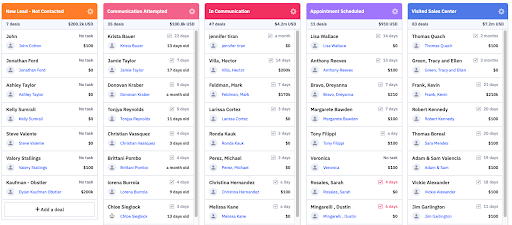
Your CRM allows you to visually see each step of the process and to manage buyer expectations and ‘next steps’. It organizes that Journey, prompts you with tasks associated with that stage, and helps communicate stage-specific information with your customer. The results are fewer panicky “what’s going on with my house” phone calls and happier, more informed buyers.
3. Spend time with Buyers” rather than “Lookers”
The bane of most salespeople is having to continually follow up with people that aren’t ready to buy. You call them, text them, email them – and get no response. Your CRM can take over much of that ‘non-engaged follow up’, giving you back the time you need to spend with qualified buyers.
You can’t be actively engaged in selling to people that aren’t actively engaged in buying. We know that most people who contact us simply aren’t yet ready to buy now; they don’t need your time and attention today. Your CRM can help identify future buyers, those who are just curious, and non-responsive leads so you can focus your full time and attention on active buyers.
4. Nurture “lookers” to turn them into Buyers
As noted, people often begin their new home discovery long before they are ready to buy. They just need preliminary answers now, not your time and attention. But that doesn’t mean you should ignore them. Just the opposite; they thrive on information that will help them plan for and ultimately act on their desire for a new home. This is where your CRM becomes invaluable by feeding them relevant, informative and motivating content to help them get ready to buy, all on autopilot without your time and attention.
A Long-Term Nurture campaign helps inspire future buyers not to give up on their dreams. It also lets them know that you haven’t given up on them, and that when they are ready, you’ll be here to serve them. In the years to come, 25-30% of your sales will be to people that were at one time in this category, buyers that you would likely have lost without your CRM.
5. Automated Follow Up
Let’s be clear: no amount of automation tools or AI-powered gizmos will ever replace professional, human salespeople. And it’s your job as a sales professional to follow up with your leads. But much of that follow up, even the human touches, can be automated.
Example: Someone submits an online inquiry. The lead comes to you, and an initial email campaign starts. You phone them, then text them, then send them an email, all without response. But your CRM sees that they’ve opened all your email, and that they’ve returned several times to your website to view the Springfield model home. Based on this activity, the CRM notifies you that you have a hot lead and sets a task for you to make another call. It also suggests talking points for your conversation and provides copy for a text message. Now, what seemed like an unresponsive lead is now revealed as your next hot buyer. That’s what a CRM can do for you!
Here we’ve covered just 5 ways your CRM can help you become more responsive, productive and profitable. We’ve just scratched the surface. To get the whole story, and to see how MhCRM can work for your company, schedule a demo today.
